Sunday, December 1, 2013

How to Handle the World's Waste

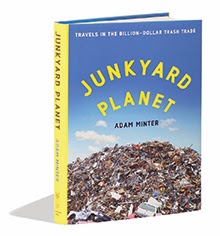
Junkyard Planet is an enjoyable and fascinating read about the multi-billion dollar global trash trade. More like a novel than a dry tome, it is full of subtle insights. 

Neither incineration nor landfill is a sustainable solution to our apparent addiction to waste, but neither is recycling always the green alternative it appears to be.


Reusing is better than recycling, and not using in the first place is best of all. While Junkyard Planet might be read as a celebration of the market, it is also critical of unbridled capitalism. For every entrepreneurial recycler, there is a product that should not be thrown away in the first place—but it is profitable for manufacturers if we do. 

Author and journalist Adam Minter, who was born into a family of scrap dealers, argues passionately that manufacturers need to make technological products that last longer and can be refitted rather than thrown away, if we are to significantly reduce our collective damage to the environment.

Read the full review in F&D magazine

Interview with Adam Minter on U.S. National Public Radio

Find on Goodreads

Review on Mother Jones

Q&A in the New York Times blog:  Part 1; Part 2


Thursday, October 24, 2013

Deaton's Great Escape


The world is a better place than it used to be. People are wealthier and healthier, and live longer lives. Yet the escapes from destitution by so many have left gaping inequalities between people and between nations. In "The Great Escape," Angus Deaton--one of the foremost experts on economic development and on poverty--tells the remarkable story of how, starting 250 years ago, some parts of the world began to experience sustained progress, opening up gaps and setting the stage for today's hugely unequal world. Deaton takes an in-depth look at the historical and ongoing patterns behind the health and wealth of nations, and he addresses what needs to be done to help those left behind.
Deaton describes vast innovations and wrenching setbacks: the successes of antibiotics, pest control, vaccinations, and clean water on the one hand, and disastrous famines and the HIV/AIDS epidemic on the other. He examines the United States, a nation that has prospered but is today experiencing slower growth and increasing inequality. He also considers how economic growth in India and China has improved the lives of more than a billion people. Deaton argues that international aid has been ineffective and even harmful. He suggests alternative efforts--including reforming incentives to drug companies and lifting trade restrictions--that will allow the developing world to bring about its own Great Escape.

Demonstrating how changes in health and living standards have transformed our lives, "The Great Escape" is a powerful guide to addressing the well-being of all nations. 


Deaton argues that the main barrier to progress in poor countries is not lack of resources but bad governments. Yet it is these governments that receive the aid either directly or indirectly. The flow of foreign money undermines governments’ incentives to raise money from their own taxpayers, which in turn requires growth-friendly policies and reformed institutions. Instead it shores up ill-functioning governments, the very misfortune holding back poor countries.


New York Times review

Princeton University press

The Economist

Bloomberg review

Article in F&D magazine

Thursday, October 3, 2013

Tuesday, September 10, 2013

Continuation of Policy by Other Means


Treasury’s War
The Unleashing of a New Era of Financial Warfare
PublicAffairs, New York, 2013, 336 pp., $27.99 (cloth).
Treasury’s War by Juan C. Zarate offers a guided tour of a decade of the U.S. government’s efforts to wield its financial and economic power to achieve its strategic interests and alter the balance of various conflicts. 
Juan Zarate is well positioned to tell this story: he joined the George W. Bush administration’s Treasury Department as a young, gregarious former prosecutor with antiterrorism credentials just months before the terrorist attacks of September 11, 2001, and eventually rose to become deputy national security advisor.­
Zarate was personally involved in many of the developments recounted in the book, including the “war on terror,” the U.S. invasion of Iraq, and efforts to contain the nuclear ambitions of North Korea and Iran and to undermine the Qaddafi and Assad regimes in Libya and Syria.
Following 9/11, financial and economic sanctions and the role of financial intelligence became increasingly important and effective tools in the U.S. national security arsenal. Zarate attributes this to several factors, including the globalization of financial markets and the central role played by the dollar in international trade transactions.
Read the full F&D magazine review.
Saturday, June 29, 2013

A Forum for Central Bankers--Taking Stock of the World's Oldest IFI

Péter Ákos Bod, Professor at Corvinus University in Budapest, discusses a new book on The Bank for International Settlements (BIS). Set up in May 1930, the BIS is the world's oldest international financial organisation, and brings together central bankers from around the world.

Bod writes in the latest F&D magazine that "the BIS is an international institution that has had to assume new roles under drastically changing global conditions. 

"Collecting banking data, conducting high-quality research, and providing prudential advice are its vital contribution to the proper functioning of modern finance. 

"The common European currency and the foundation of the European Central Bank presented the BIS with new challenges, as does the growing importance of the so-called BRICS (Brazil, Russia, India, China, South Africa) and other emerging economies, whose central banks want to be heard and taken into account. The BIS will continue and prosper if it keeps reacting as innovatively and efficiently to the objective demands of international high finance as it has throughout its existence.­"

Friday, May 10, 2013

Pulling Together in the Eastern Caribbean

The Eastern Caribbean Economic and Currency Union (OECS/ECCU) is one of four currency unions in the world. 

As in other parts of the world in the aftermath of the global economic and financial crisis, the region is at a crossroads, facing the major challenges of creating jobs, making growth more inclusive, reforming the banking system, and managing volatility, while grappling with high public debt and persistent low economic growth. Policymakers have the critical task of implementing strong reforms to strengthen the monetary union while also laying the foundation for accelerating growth. 

A new handbook provides a comprehensive analysis of the key issues in the OECS/ECCU, including its organization and economic and financial sector linkages, and provides policy recommendations to foster economic growth.

In an interview with IMF Survey magazine, economist Alfred Schipke, who is one of the authors, points out that, while the recent global financial crisis exposed significant weaknesses in the ECCU, it also provides a unique opportunity to move forward with needed reforms to strengthen the union.

Schipke recently co-edited The Eastern Caribbean Economic and Currency Union: Macroeconomics and Financial Systems, which was launched at IMF Headquarters in Washington, DC. IMF Deputy Managing Director Min Zhu, in his opening remarks, reflected on the challenges facing small island economies, particularly with loss of market share in the tourism industry, the mainstay of the economy in most of the island states. 

He said that the IMF and its partners can do a better job in helping the region to further push macroeconomic, as well as structural, reforms, and noted that the new book would help in providing a framework for developing solutions to the ECCU’s financial sector problems and stimulating economic growth.

Friday, April 19, 2013

Tailored Approach to Managing Public Finances

A new book by the IMF--Public Financial Management and Its Emerging Architecture--looks at reforms introduced by governments over the past two decades to improve management of public finances. These innovative ideas and reforms are changing the landscape of public finances and eventually aim to fundamentally change the way governments manage the public’s money.
The global financial and economic crisis highlighted the importance of sound public financial management in ensuring that well-designed fiscal policies are implemented effectively. Sound management of public finances means maintaining a sustainable fiscal position, allocating resources efficiently, and delivering public goods and services effectively.
The book looks at how reforms to public financial management make use of new information, processes, and rules to change the behavior of politicians and public servants to counter the ongoing challenges of managing government’s money. As identified in the book, too often the tendency for policymakers is to spend rather than save in good times; to focus on the short term; and to ignore the future costs of new policies, underlying fiscal risk, and the true state of public finances.
“The global crisis has highlighted that reforming governments’ management of public finances is no longer an option but a necessity. There is no ‘one-size-fits-all’ solution—reforms need to be tailored to countries’ individual circumstances,” said IMF Deputy Managing Director, Min Zhu, who addressed officials, journalists, and academics gathered at a special seminar to discuss the findings in the book.

IMF Survey article 

Book launch and Seminar on Public Financial Management and Its Emerging Architecture

Background and comments