Showing posts with label China. Show all posts

Saturday, March 22, 2014

An Alternative Easterly Road to Development

Over the past century, global poverty has largely been viewed as a technical problem that merely requires the right “expert” solutions. Yet all too often, experts recommend solutions that fix immediate problems without addressing the systemic political factors that created them in the first place. Further, they produce an accidental collusion with “benevolent autocrats,” leaving dictators with yet more power to violate the rights of the poor.
In The Tyranny of Experts, New York University economics professor William Easterly, bestselling author of The White Man’s Burden, traces the history of the fight against global poverty, showing not only how these tactics have trampled the individual freedom of the world’s poor, but how in doing so have suppressed a vital debate about an alternative approach to solving poverty: freedom.
 Presenting a wealth of cutting-edge economic research, Easterly argues that only a new model of development—one predicated on respect for the individual rights of people in developing countries, that understands that unchecked state power is the problem and not the solution —will be capable of ending global poverty once and for all.

Review in the Wall St Journal  by Sarah Chayes
"Mr. Easterly's alternative to the autocrat-driven, technocratic model of development is simple: Apply abroad what we know has worked at home—bottom-up solutions, a free flow of ideas leading to innovative experiments and democratic politics."
Review by Geoff Lamb (who works for the Bill and Melinda Gates Foundation)
"It’s an odd jumble of a book."
Review by David Roodman
"Through choice quotes, an Easterly trademark, the book dramatizes how rife is the “technocratic illusion” in the development business today. In particular, the technocratic illusion “would capture Bill Gates and Tony Blair” and World Bank president Jim Kim."
"In sum, I think this book, like its predecessor, gets tripped up in places by ill-defined abstractions. Just as searchers and planners are usually the same (when Steve Jobs’s told his people to create the iPad, was that top-down planning or “spontaneous” problem solving by a market actor?), the phraseology in “tyranny of experts” tends to blur distinct groups. There are autocrats who adopt with various degrees of sincerity the rhetoric of centrally planned development and then use it to rationalize human rights violations. There are foreign institutions that collaborate with them, sometimes for the best humanitarian reasons, sometimes out of geo-realpolitik. There are the less-powerful human beings within those institutions, who are seemingly the “experts” and “economists” in this book’s title. I think it is a mistake to simply tar one group with the sins of another."
Hear it on Audible

Tuesday, February 11, 2014

New Books on China

Couple of good books on China from the IMF

China's Economy in Transition: 

From External to Internal Rebalancing


China’s current account surplus has declined to around one-quarter the peak reached before the global financial crisis. While this is a major reduction in China’s external imbalance, it has not been accompanied by a decisive shift toward consumption-based growth. Instead, the compression in its external surplus has been accomplished through increasing fixed investment so that it is now an even higher share of China’s national economy. 

This increasing reliance on fixed investment as the main driver of China’s growth raises questions about the durability of the compression in the external surplus and the sustainability of the current growth model that has had unprecedented success in lifting about 500 million people out of poverty over the last three decades. This volume examines various aspects of the rebalancing process underway in China, highlighting policy lessons for achieving stable, sustainable, and inclusive growth.

on Amazon   Google  Discussion at Carnegie


China has reached a stage where further financial sector reforms appear essential. As the reform process progresses and macrofinancial linkages deepen, the preservation of financial stability will become a major policy preoccupation. China is already working toward enhancing its surveillance and monitoring capabilities and is actively determining ways to undertake a series of reforms that would lay the foundation for a strong, sustained, and balanced growth. 

"China’s Road to Economic Stability" focuses on the key financial policy issues facing China today. The volume draws upon contributions from senior Chinese authorities and academics, as well as staff from the IMF to discuss the financial policy context within China, macroeconomic factors affecting financial stability, and the critical role of financial system oversight. It seeks to improve the understanding of the financial sector policy processes underway and the shifts taking place among China’s economic priorities. 

The book also covers issues such as the financial stability framework, systemic linkages, liquidity management, risk and vulnerability analysis, and sequencing financial reforms. The book is something of a must read for academics, researchers, and stakeholders interested in China and the shifts taking place in the manner in which China views its financial sector policies and oversees the stability of the financial system.

Sunday, December 1, 2013

How to Handle the World's Waste

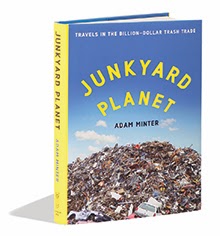
Junkyard Planet is an enjoyable and fascinating read about the multi-billion dollar global trash trade. More like a novel than a dry tome, it is full of subtle insights. 

Neither incineration nor landfill is a sustainable solution to our apparent addiction to waste, but neither is recycling always the green alternative it appears to be.


Reusing is better than recycling, and not using in the first place is best of all. While Junkyard Planet might be read as a celebration of the market, it is also critical of unbridled capitalism. For every entrepreneurial recycler, there is a product that should not be thrown away in the first place—but it is profitable for manufacturers if we do. 

Author and journalist Adam Minter, who was born into a family of scrap dealers, argues passionately that manufacturers need to make technological products that last longer and can be refitted rather than thrown away, if we are to significantly reduce our collective damage to the environment.

Read the full review in F&D magazine

Interview with Adam Minter on U.S. National Public Radio

Find on Goodreads

Review on Mother Jones

Q&A in the New York Times blog:  Part 1; Part 2


Monday, March 18, 2013

Democracy Pays Off

Why Nations Fail: The Origins of Power, Prosperity, and PovertyWhy Nations Fail: The Origins of Power, Prosperity, and Poverty by Daron Acemoğlu
My rating: 5 of 5 stars

A nation's poverty or prosperity may have as much to do with politics as economics, says Daron Acemoglu.

The MIT professor argues that more democratic countries with inclusive political institutions create sustained prosperity, while “extractive” authoritarian regimes lead toward poverty.

Acemoglu discusses why China is not the exception.

Listen to an interview with Acemoglu: http://www.imf.org/external/podcast/2...